The Biology Beneath Bedtime: the interplay between Melatonin & Cortisol
Jul 13, 2026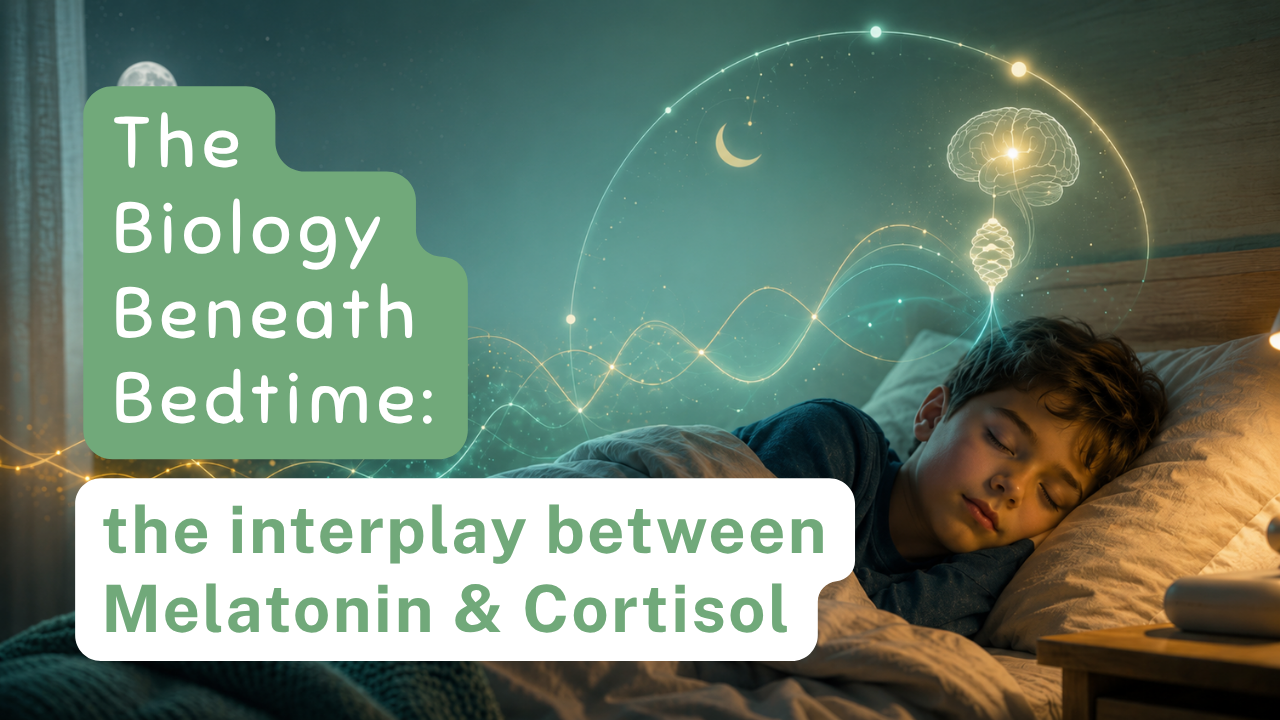
By Kerry Evetts | BOccTher, MOT | Occupational Therapist | SenseUp Training
Bringing OTs back to the science, so families get the expert support they deserve.
Sleep is the end point of a complex biological cascade that begins hours before lights-out. It involves multiple interacting neurohormonal systems and requires a sequence of physiological conditions to be in place before sleep onset becomes possible.
For the children on our caseloads, this cascade is frequently disrupted.
Understanding this is a game changer for paediatric OT practice because it shifts sleep support beyond the question of “What should the bedtime routine look like?” and toward a more clinically useful question:
What biological and regulatory conditions does this child need in order to access sleep?
This blog focuses on two biological systems highly relevant to paediatric sleep difficulty: the melatonin pathway and the cortisol stress axis. Each has direct clinical relevance to our assessment and intervention.
Melatonin
Melatonin is commonly framed as a sleep hormone that “makes you sleepy.” The biology is more nuanced.
Melatonin is produced by the pineal gland in response to darkness. It does not induce sleep in the same way a sedative does. Rather, it helps signal darkness to the brain and supports the circadian phase shift that prepares the body for sleep. Melatonin is best understood as a timing signal, not a sedative.
In typically developing children and adolescents, endogenous melatonin onset occurs before habitual sleep time. This window is referred to as dim-light melatonin onset, or DLMO. The exact timing varies by age, developmental stage, light exposure, and methodology, but it is clinically important because it tells us when the body has biologically begun preparing for sleep.
In children and adolescents with delayed sleep phase, DLMO may be shifted later. This means the biological drive toward sleep may not have begun at the time the family is attempting lights-out (Eckerberg et al., 2012).
This circadian misalignment cannot be fully addressed by bedtime routine alone.
Research in autistic populations has identified disrupted melatonin synthesis and circadian rhythm differences as potential biological contributors to sleep difficulty. Melke et al. (2008) found abnormal melatonin synthesis in autism spectrum disorders, including evidence linked to the ASMT gene, which encodes an enzyme involved in the melatonin synthesis pathway. Tordjman et al. (2005) also reported significantly lower nocturnal 6-sulphatoxymelatonin excretion in children and adolescents with autistic disorder compared with controls.
Therefore, when assessing the sleep of an autistic child, particularly when the child consistently cannot fall asleep despite an appropriate environment and routine, a disrupted melatonin or circadian pathway should be considered as one possible contributing factor.
This does not mean OTs diagnose melatonin abnormalities or prescribe melatonin. It means we recognise when sleep difficulty may have a biological rhythm component and when referral or collaboration with the child’s paediatrician, GP, sleep physician, or broader care team is appropriate.
Light exposure is one of the most clinically relevant entry points for OT assessment. Blue-enriched light exposure, including light from screens, can suppress melatonin production and delay circadian timing (Brainard et al., 2001). This is why screen recommendations in sleep hygiene exist.
However, the OT assessment needs to go beyond “reduce screens before bed.” We need to assess the full light environment across the day and evening, including morning light exposure, classroom lighting, after-school indoor light exposure, evening overhead lighting, bedroom lighting, and screen use.
Understanding the why allows OTs to communicate recommendations to families in a way that is more practical, more respectful, and more likely to be implemented.
Cortisol
Cortisol is the primary glucocorticoid produced by the adrenal cortex in response to activation of the hypothalamic-pituitary-adrenal axis, or HPA axis.
In typical sleep physiology, cortisol follows a diurnal rhythm. Levels are generally lower during the early part of the night, rise gradually across the later sleep period, and peak around the morning waking period as part of the cortisol awakening response, which helps prepare the body for the demands of the day (Clow et al., 2004; Buckley & Schatzberg, 2005).
The HPA axis plays an important role in maintaining alertness and modulating sleep-wake physiology. When stress physiology remains elevated into the evening, the biological conditions required for sleep onset can be compromised.
Clinically, this matters because a child may appear behaviourally “ready for bed” while their body remains physiologically mobilised.
For children with sensory processing differences, cumulative sensory demands across the day may contribute to physiological arousal and stress load. A child who has spent the school day managing noise, unpredictable transitions, tactile discomfort, social demands, visual stimulation, postural effort, and emotional masking may arrive home with a nervous system that has been working hard all day.
That child may not simply need a better bedtime routine.
They may need a day that is less physiologically expensive.
They may need sensory and regulatory support much earlier in the day so that bedtime is not carrying the full burden of accumulated stress.
Research has linked sensory hypersensitivity with sleep difficulties in children, including sleep onset difficulties and poorer sleep quality (Shochat et al., 2009). This does not mean sensory overload directly “causes” cortisol elevation in every child, but it does support the clinical relevance of assessing sensory demands, arousal, and sleep together.
Parent-child regulation is also part of this picture. Feldman’s work on parent-infant synchrony highlights the relational and physiological nature of early regulation (Feldman, 2007). In clinical terms, this means the parent’s stress state can influence the quality of co-regulatory interaction at bedtime.
This is not about blaming parents.
It is about understanding that exhausted parents cannot always provide calm, consistent, connected co-regulation simply because we advise them to do so. Parent capacity is part of the clinical picture.
OTs are therefore assessing the child’s full sensory and physiological day. We are looking at where stress load is being accumulated, which environments and demands may be sustaining arousal, and what conditions may support regulation across the day and evening.
We often talk about sleep preparation starting from the time the child wakes up in the morning.
The Interplay
Melatonin and cortisol do not operate as independent systems. They sit within the broader relationship between circadian rhythm, stress physiology, arousal, body temperature, light exposure, and sleep-wake regulation.
Elevated evening stress physiology may interfere with the biological conditions that support sleep onset. This may include delayed downregulation, increased alertness, altered body temperature patterns, and disrupted circadian timing (Buckley & Schatzberg, 2005).
For children with sensory processing differences, trauma histories, anxiety, neurodevelopmental differences, or chronic environmental stress, this interplay can create a self-reinforcing cycle.
Cumulative sensory and emotional demands increase physiological arousal.
Physiological arousal makes sleep onset more difficult.
Poor sleep reduces the child’s regulatory resources the next day.
Lower regulatory capacity increases sensory vulnerability and stress load.
The next bedtime then begins from an even more depleted baseline.
Each difficult night can make the following day harder, and each dysregulated day can make the next night harder.
Pesonen et al. (2012) found associations between stress-related cortisol patterns and sleep problems in childhood. This supports the broader clinical point that sleep should not be assessed only in the immediate pre-sleep window. We need to understand what is happening across the whole day.
This is a clinically significant distinction.
It shifts our assessment from “What happens at bedtime?” to “What is the child’s nervous system carrying by the time bedtime arrives?”
What This Means for OT Assessment and Intervention
The biological mechanisms described in this blog require OTs to practise within scope with greater neurobiological depth.
This may include:
Assessing the light environment across the full day.
Assessing sensory inputs and environmental demands that may be contributing to physiological arousal across the school and home day.
Considering whether the child’s sleep timing may reflect circadian misalignment rather than behavioural resistance.
Identifying when an autistic child’s sleep presentation may require referral or collaboration with a medical or sleep team.
Exploring how parent stress and family exhaustion are affecting co-regulation and implementation capacity.
Supporting families with practical, respectful psychoeducation about light exposure, sensory regulation, arousal, and sleep readiness.
Recommending occupation-based and sensory-informed regulation strategies, such as proprioceptive input, rhythmic movement, breathing-based regulation, warm water routines, predictable transition cues, and environmental modifications.
The role of the OT is not to diagnose endocrine dysfunction or provide medical treatment for sleep disorders. The role of the OT is to identify the occupational, sensory, environmental, relational, and regulatory factors that may be contributing to sleep difficulty, and to know when broader referral or collaborative care is needed.
In my work, I find it genuinely useful for families to understand these biological mechanisms in simple, practical terms. When families understand why we are recommending something, they are often better able to follow through with consistency and clarity.
Instead of hearing, “Reduce screen time,” they hear, “We are helping the brain receive a clearer darkness signal.”
Instead of hearing, “Calm them down before bed,” they hear, “We are reducing the stress load across the day so the nervous system is not trying to sleep from a state of mobilisation.”
Instead of hearing, “Try a better routine,” they hear, “We are creating the biological and sensory conditions that make sleep more accessible.”
That is a very different clinical conversation.
The SenseUp Masterclass on Sensory Contributions to Sleep
provides OTs with a neuroscience-informed, trauma-aware, occupation-centred assessment and intervention framework for paediatric sleep difficulties. It is grounded in current evidence and applied through clinical case reasoning.
Join the next masterclass.
Register here → 2026 Sensory Contributions to Sleep
Kerry Evetts BOccTher, MOT, is an occupational therapist with over 27 years of paediatric clinical experience and the founder of SenseUp Therapies and SenseUp Training. The SenseUp Model integrates polyvagal theory, sensory integration, trauma-informed practice, and occupational participation into a unified clinical framework for paediatric OT.
Kerry’s mission: one million children, through better-supported therapists.
I do the research so you don’t have to.
senseup.org | [email protected]
References
Brainard, G. C., Hanifin, J. P., Greeson, J. M., Byrne, B., Glickman, G., Gerner, E., & Rollag, M. D. (2001). Action spectrum for melatonin regulation in humans: Evidence for a novel circadian photoreceptor. Journal of Neuroscience, 21(16), 6405–6412. https://doi.org/10.1523/JNEUROSCI.21-16-06405.2001
Buckley, T. M., & Schatzberg, A. F. (2005). On the interactions of the hypothalamic-pituitary-adrenal axis and sleep: Normal HPA axis activity and circadian rhythm, exemplary sleep disorders. Journal of Clinical Endocrinology & Metabolism, 90(5), 3106–3114. https://doi.org/10.1210/jc.2004-1056
Clow, A., Thorn, L., Evans, P., & Hucklebridge, F. (2004). The awakening cortisol response: Methodological issues and significance. Stress, 7(1), 29–37. https://doi.org/10.1080/10253890410001667205
Eckerberg, B., Lowden, A., Nagai, R., & Åkerstedt, T. (2012). Melatonin treatment effects on adolescent students’ sleep timing and sleepiness in a placebo-controlled crossover study. Chronobiology International, 29(9), 1239–1248. https://doi.org/10.3109/07420528.2012.719962
Feldman, R. (2007). Parent-infant synchrony and the construction of shared timing: Physiological precursors, developmental outcomes, and risk conditions. Journal of Child Psychology and Psychiatry, 48(3–4), 329–354. https://doi.org/10.1111/j.1469-7610.2006.01701.x
Melke, J., Goubran Botros, H., Chaste, P., Betancur, C., Nygren, G., Anckarsäter, H., Rastam, M., Ståhlberg, O., Gillberg, I. C., Delorme, R., Chabane, N., Mouren-Simeoni, M. C., Fauchereau, F., Durand, C. M., Chevalier, F., Drouot, X., Collet, C., Launay, J. M., Leboyer, M., & Bourgeron, T. (2008). Abnormal melatonin synthesis in autism spectrum disorders. Molecular Psychiatry, 13(1), 90–98. https://doi.org/10.1038/sj.mp.4002052
Pesonen, A. K., Räikkönen, K., Heinonen, K., Andersson, S., Hovi, P., Järvenpää, A. L., Eriksson, J. G., & Kajantie, E. (2012). Stress and sleep: A relationship between cortisol awakening response and sleep problems in childhood. Developmental Psychology, 48(5), 1416–1425. https://doi.org/10.1037/a0027034
Shochat, T., Tzischinsky, O., & Engel-Yeger, B. (2009). Sensory hypersensitivity as a contributing factor in the relation between sleep and behavioural disorders in normal schoolchildren. Behavioral Sleep Medicine, 7(1), 53–62. https://doi.org/10.1080/15402000802577777
Tordjman, S., Anderson, G. M., Pichard, N., Charbuy, H., & Touitou, Y. (2005). Nocturnal excretion of 6-sulphatoxymelatonin in children and adolescents with autistic disorder. Biological Psychiatry, 57(2), 134–138. https://doi.org/10.1016/j.biopsych.2004.11.003
Stay connected with news and updates!
Join our mailing list to receive the latest news and updates from our team.
Don't worry, your information will not be shared.
We hate SPAM. We will never sell your information, for any reason.