What Lies Beneath Sleep Hygiene Strategies, and Why Paediatric OTs Are Uniquely Placed to Help
Jul 09, 2026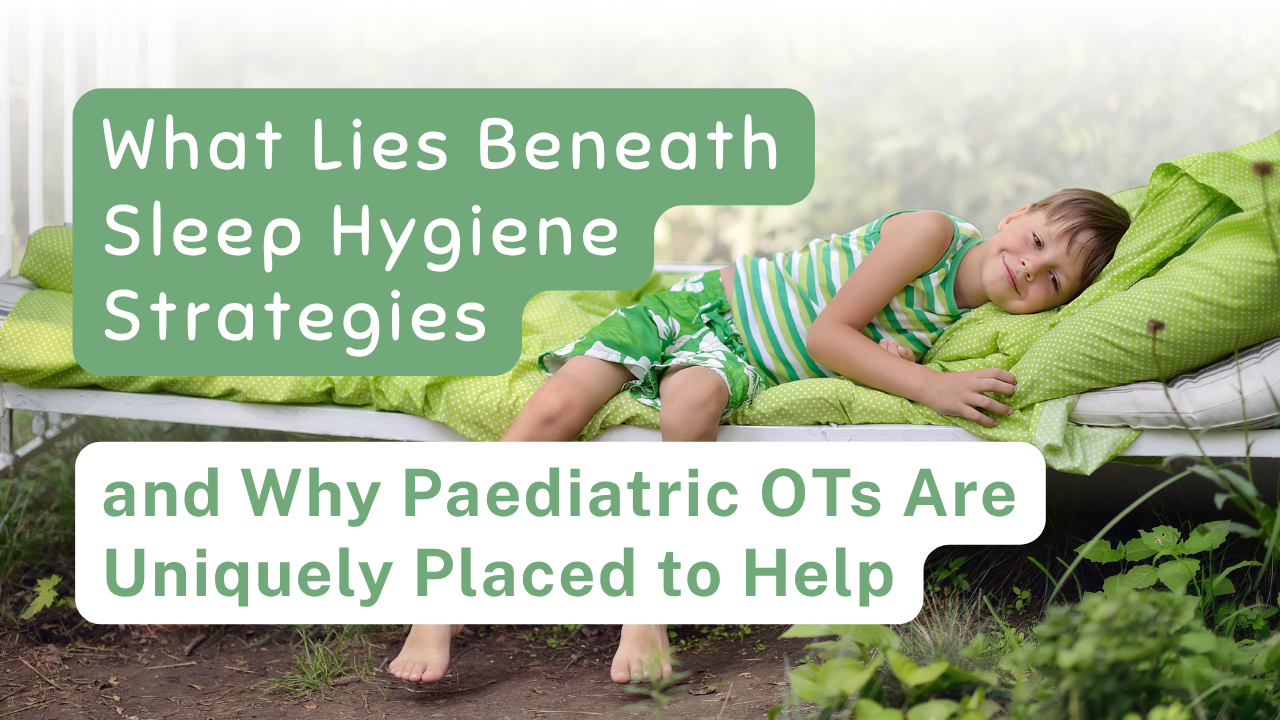
By Kerry Evetts | BOccTher, MOT | Occupational Therapist | SenseUp Training
Bringing OTs back to the science, so families get the expert support they deserve.
Sleep difficulties are among the most common concerns raised in paediatric occupational therapy practice, yet they can remain one of the most elusive areas to shift through standard advice alone. Research consistently indicates that sleep difficulties are common in childhood, affecting approximately 25 to 40 percent of children and adolescents. Prevalence is particularly high in autistic children, often reported in the 50 to 80 percent range, and children with ADHD are also significantly more likely to experience sleep-related difficulties than typically developing peers (Mindell et al., 2008; Richdale & Schreck, 2009; Cortese et al., 2009).
These are the children on our caseloads.
Despite how common sleep problems are for our clients, many OT clinical frameworks for sleep assessment and intervention have remained focused on surface-level behavioural and environmental recommendations. These recommendations still matter, but for many children, they are not enough on their own.
Standard OT support often includes sleep hygiene, routine establishment, environmental modification, and psychoeducation for the family and child. In my clinical experience, OTs have not always been equipped with a framework for the neurobiological complexity that underpins sleep difficulties in the children and families we most commonly support.
The Limitations of a Behavioural Framework
Sleep hygiene interventions are often founded on a behavioural framework. They address what the child and family do in the period before sleep, including limiting screen time, preparing for bed, creating calming routines, and adjusting the bedroom environment.
These recommendations are relevant and still form part of the intervention strategy. However, their success depends on something more foundational: whether the child’s nervous system has sufficient regulatory capacity to access sleep.
If we do not look beneath sleep hygiene, we may be missing a significant part of the sleep picture.
This is when parents arrive at the next session saying, “Nothing is working.” They are exhausted. Everyone is cranky. The family has tried the routine, the visuals, the low lighting, the reduced screen time, the bedtime chart, the calming playlist, and the consistent wake-up time.
And the OT, having perhaps offered the full limit of their knowledge and experience in this area, is left with few places to go.
The Parental Stress Variable
Before assessing the neurobiological mechanisms underlying the child’s sleep difficulty, we also need to consider the psychological and physiological state of the parent.
Research by Meltzer and Mindell (2007) identified a significant relationship between paediatric sleep disturbance and parental sleep deprivation, mood, and parenting stress. Parents of children with chronic sleep difficulties are not only tired. They may also be carrying shame, particularly when sleep difficulties have been implicitly or explicitly framed as a parenting failure.
They have often already tried many things. They have been given advice from professionals, family members, social media, books, and online forums. Not only is the sleep difficulty still present, but the parent’s belief in their ability to support their child may now be eroded. They may feel disempowered, desperate, and guarded.
Parents who live in a state of chronic stress, self-doubt, and hypervigilance around bedtime may be less available for the kind of co-regulatory support their child’s nervous system requires. They may also view new advice with scepticism, protective guardedness, or exhausted compliance that is unlikely to be sustainable.
From a polyvagal-informed perspective, co-regulation requires the regulated adult nervous system to support the state regulation of the child (Porges, 2011; Porges & Dana, 2018). A stressed and exhausted parent who approaches bedtime braced, tense, and physiologically depleted may struggle to provide the prosodic, warm, calm presence that helps signal safety to the child.
As OTs, we are uniquely positioned to notice this and support parents through compassionate education, practical environmental adaptation, and referral when needed. Our work should not add harm to the parent or child by simply repeating sleep hygiene advice that the family cannot receive, implement, or sustain in their current state.
What Lies Beneath: The Neuroscience
Autonomic State as a Prerequisite for Sleep
Polyvagal theory provides a useful clinical lens for understanding why sleep onset can elude children who, by all observable measures, “should” be able to sleep (Porges, 2011). From this perspective, sleep onset becomes more accessible when the nervous system has sufficient cues of safety and reduced threat monitoring to allow physiological downregulation.
A child presenting with prolonged sleep onset latency, frequent night waking, or persistent bedtime protest may not simply be resisting sleep. Their nervous system may still be engaged in monitoring, mobilisation, or protection.
The clinical implication is significant: autonomic state needs to be considered before we assume that sleep hygiene alone will be enough.
Porges and Dana (2018) describe neuroception as the nervous system’s unconscious detection of safety, danger, or life threat. For children whose neuroceptive systems have been sensitised by experience, sensory overwhelm, relational stress, or unpredictability, the bedtime environment may not automatically signal safety.
The room may be quiet, but the child’s nervous system may still be listening for threat.
Sensory Processing and the Active Demands of Sleep Onset
Ayres’ sensory integration theory (1972) frames the nervous system as an active processor of sensory information, continuously organising input from the environment and from the body itself.
Sleep onset requires this processing system to do something quite demanding. It must filter and modulate incoming sensory information, reduce orientation to environmental stimuli, support a shift in arousal, and allow the child to disengage from monitoring.
For children without significant sensory processing differences, this transition may occur relatively automatically. For children with sensory differences, it can be effortful, inconsistent, or neurologically inaccessible without targeted support.
Shochat, Tzischinsky, and Engel-Yeger (2009) demonstrated a relationship between sensory hypersensitivity and sleep difficulties in school-age children. Mazurek and Petroski (2015) extended this area of evidence in autistic children, demonstrating that sensory over-responsivity and anxiety both contribute meaningfully to sleep problems.
This has direct relevance for paediatric OT practice. Sleep onset is not only about whether the child is “calm.” It is about how the child’s nervous system is processing touch, sound, movement, light, internal body cues, and environmental predictability.
Interoception may also be clinically relevant. Interoceptive differences can influence how children notice, interpret, and respond to internal body cues such as fatigue, hunger, temperature, discomfort, pain, and the need for the toilet (Mahler, 2017). While interoception should not be assumed as the cause of sleep difficulty, it is an important area to assess when a child appears disconnected from tiredness cues, struggles to recognise sleep readiness, or misinterprets internal body sensations at bedtime.
Standard sleep hygiene does not adequately assess sensory processing, interoception, or the child’s regulatory capacity. Again, the framework is not looking deep enough.
Trauma, Adverse Experience, and the Neurobiology of Vigilance
Sleep is, neurobiologically, an act of vulnerability. It requires the nervous system to release some degree of monitoring for safety.
For children whose nervous systems have been shaped by trauma, adverse childhood experiences, disrupted attachment, medical stress, chronic environmental unpredictability, or cumulative sensory distress, this release may be difficult.
Van der Kolk (2015) describes how trauma can recalibrate the threat detection system, lowering the threshold at which environmental stimuli are appraised as dangerous. Paediatric trauma literature also recognises sleep disturbance as a common and clinically significant feature in children with post-traumatic stress presentations (Kovachy et al., 2013).
This matters because a child who cannot settle into sleep may not be choosing not to sleep. Their nervous system may be prioritising protection.
A trauma-informed lens does not require confirmed adverse childhood experiences. It asks us to consider whether the child’s nervous system may have learned that letting go is unsafe, that separation is threatening, that the dark is unpredictable, or that the body needs to stay alert.
This can include children with known trauma histories, but it can also include children experiencing chronic sensory distress, relational unpredictability, repeated medical procedures, school-based stress, or family stress around bedtime.
The Occupational Therapy Scope
The Occupational Therapy Practice Framework recognises rest and sleep as occupational domains, including rest, sleep preparation, and sleep participation (AOTA, 2020).
This matters. Sleep is not outside OT scope. It is occupationally central.
As OTs, we can integrate sensory processing assessment, autonomic regulation frameworks, trauma-informed practice, and occupation-centred goal setting into a single clinical approach. We can anchor sleep intervention in meaningful participation goals within the family unit.
The research evidence is clear enough to require more than generic sleep hygiene for many of the children we support. Paediatric sleep difficulties in neurodevelopmental and sensory-based caseloads are often complex. They may involve autonomic dysregulation, sensory processing differences, anxiety, trauma-related vigilance, interoceptive differences, environmental mismatch, and the compounding effects of parental stress and family exhaustion.
They cannot always be reliably addressed through behavioural strategies applied in the absence of a framework that accounts for these mechanisms.
The clinical question is therefore not simply:
Which strategies should we try?
It is:
What is the neurobiological and occupational story beneath this child’s sleep difficulty, and what does that story require of our assessment and intervention?
Assessing autonomic state, mapping sensory processing, understanding the family dynamic and sleep history, and considering parental stress and capacity for co-regulation changes the quality of our clinical reasoning.
The intervention becomes more individualised, more targeted, and more compassionate. The family’s experience begins to shift from “nothing is working” to “this finally makes sense.”
The SenseUp Masterclass on Sensory Contributions to Sleep
provides OTs with a neuroscience-informed, trauma-aware, occupation-centred assessment and intervention framework for paediatric sleep difficulties. It is grounded in current evidence and applied through clinical case reasoning.
The research has been done. The framework is ready. Join the next masterclass.
Register here → 2026 Sensory Contributions to Sleep
Kerry Evetts BOccTher, MOT, is an occupational therapist with over 27 years of paediatric clinical experience and the founder of SenseUp Therapies and SenseUp Training. The SenseUp Model integrates polyvagal theory, sensory integration, trauma-informed practice, and occupational participation into a unified clinical framework for paediatric OT.
Kerry’s mission: one million children, through better-supported therapists.
I do the research so you don’t have to.
senseup.org | [email protected]
References
American Occupational Therapy Association. (2020). Occupational therapy practice framework: Domain and process (4th ed.). American Journal of Occupational Therapy, 74(Suppl. 2), 7412410010. https://doi.org/10.5014/ajot.2020.74S2001
Ayres, A. J. (1972). Sensory integration and learning disorders. Western Psychological Services.
Cortese, S., Faraone, S. V., Konofal, E., & Lecendreux, M. (2009). Sleep in children with attention-deficit/hyperactivity disorder: Meta-analysis of subjective and objective studies. Journal of the American Academy of Child and Adolescent Psychiatry, 48(9), 894–908. https://doi.org/10.1097/CHI.0b013e3181ac09c9
Kovachy, B., O’Hara, R., Hawkins, N., Gershon, A., Primeau, M. M., Madej, J., & Carrion, V. (2013). Sleep disturbance in pediatric PTSD: Current findings and future directions. Journal of Clinical Sleep Medicine, 9(5), 501–510. https://doi.org/10.5664/jcsm.2678
Mahler, K. (2017). Interoception: The eighth sensory system. AAPC Publishing.
Mazurek, M. O., & Petroski, G. F. (2015). Sleep problems in children with autism spectrum disorder: Examining the contributions of sensory over-responsivity and anxiety. Sleep Medicine, 16(2), 270–279. https://doi.org/10.1016/j.sleep.2014.11.006
Meltzer, L. J., & Mindell, J. A. (2007). Relationship between child sleep disturbances and maternal sleep, mood, and parenting stress: A pilot study. Journal of Family Psychology, 21(1), 67–73. https://doi.org/10.1037/0893-3200.21.1.67
Mindell, J. A., & Meltzer, L. J. (2008). Behavioural sleep disorders in children and adolescents. Annals of the Academy of Medicine, Singapore, 37(8), 722–728.
Porges, S. W. (2011). The polyvagal theory: Neurophysiological foundations of emotions, attachment, communication, and self-regulation. W. W. Norton & Company.
Porges, S. W., & Dana, D. (Eds.). (2018). Clinical applications of the polyvagal theory: The emergence of polyvagal-informed therapies. W. W. Norton & Company.
Richdale, A. L., & Schreck, K. A. (2009). Sleep problems in autism spectrum disorders: Prevalence, nature, and possible biopsychosocial aetiologies. Sleep Medicine Reviews, 13(6), 403–411. https://doi.org/10.1016/j.smrv.2009.02.003
Shochat, T., Tzischinsky, O., & Engel-Yeger, B. (2009). Sensory hypersensitivity as a contributing factor in the relation between sleep and behavioural disorders in normal schoolchildren. Behavioral Sleep Medicine, 7(1), 53–62. https://doi.org/10.1080/15402000802577777
van der Kolk, B. A. (2015). The body keeps the score: Brain, mind, and body in the healing of trauma. Penguin Books.
Stay connected with news and updates!
Join our mailing list to receive the latest news and updates from our team.
Don't worry, your information will not be shared.
We hate SPAM. We will never sell your information, for any reason.