How does unexpected touch inadvertently create trauma in some children with cerebral palsy?
Oct 08, 2026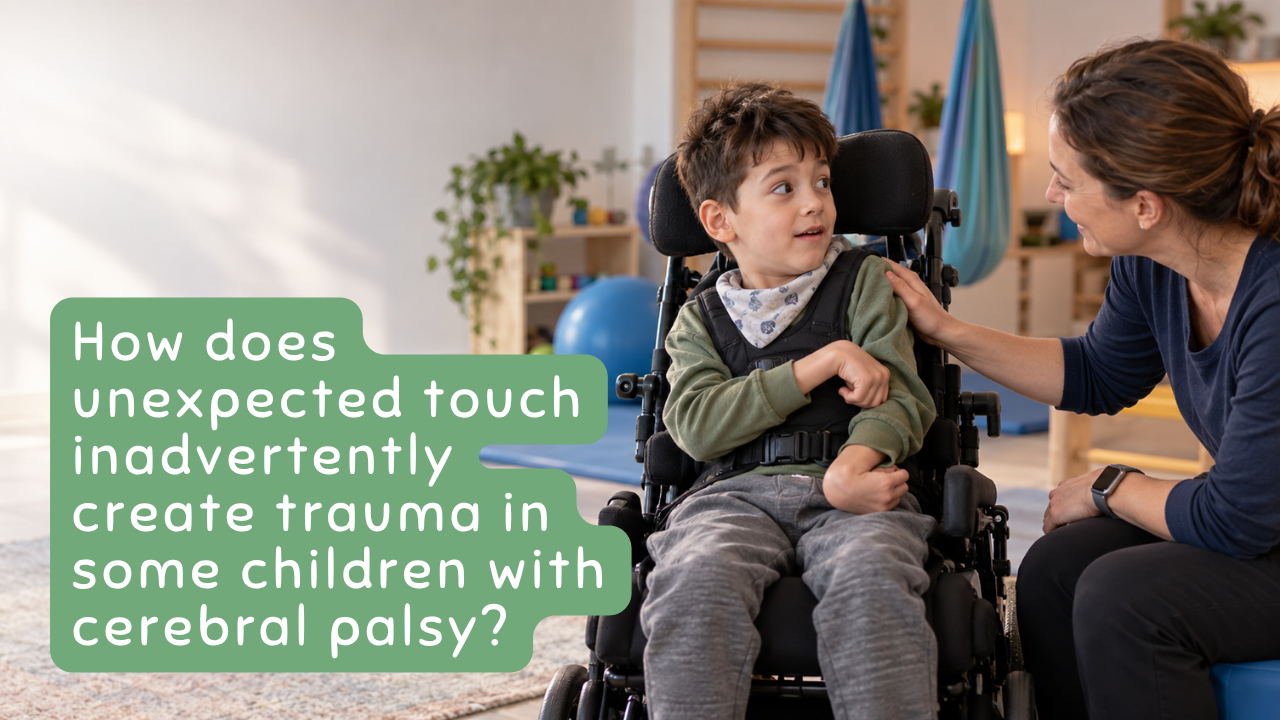
The neuroscience of tactile processing, nervous system threat, and the clinical case for choice in handling.
Think about the last time someone touched you without asking. A colleague who straightened your collar. A stranger who guided you by the elbow. For most adults, this is mildly uncomfortable at best. For a child with cerebral palsy (CP) who has been touched by medical professionals since birth often during painful or frightening procedures the experience of being physically handled carries a very different weight.
What the tactile system is doing in CP
The tactile system operates through two distinct fibre pathways. A-beta fibres carry discriminative touch to tell the brain where contact was made, with what pressure, and what texture or shape. C-tactile (CT) afferents carry affective touch. These are slow, unmyelinated fibres that respond to gentle, stroking contact and project to the insular cortex, which is central to both interoception and social bonding. In children without neurological differences, these two systems work in concert but in cerebral palsy, both are frequently disrupted.
There is a further complication called tactile defensiveness. Many children with CP are significantly more reactive to light, unpredictable, or unexpected touch than to firm, predictable deep pressure. This reflects a nervous system in which threat-detection pathways are dominating over the discriminative and affective touch pathways.
💭 BEFORE YOU INTERPRET THE RESPONSE
If a child braces or pulls away before contact even happens, are we only seeing tactile sensitivity, or could they also be anticipating what usually comes next?
A history of touch that was not chosen
Children with cerebral palsy often have a medical history that would tax any nervous system. NICU admissions. Intubation. Physiotherapy that involved sustained stretching or uncomfortable positioning. Splinting. Surgery. Repeated, unwanted, and sometimes painful touch, none of it chosen, and much of it outside the child's ability to anticipate or control.
This matters because of what the nervous system learns from experience. Through a Polyvagal lens (Porges, 2011), touch from a trusted person within a state of safety activates the ventral vagal system and it is regulatory, connecting, even analgesic. Touch that signals unpredictability, threat, or pain activates the sympathetic or dorsal vagal branch instead. The nervous system is responding to its own accumulated experience of what touch has historically meant. This is not a choice.
Spasticity measurably increases when the nervous system is in a sympathetic state. The tone we are trying to manage through handling is directly influenced by whether the child feels safe during that handling.
Managing tone often requires managing nervous system state first.
💭 BEFORE YOU WORK ON “TOLERANCE”
How much does this child know about what is about to happen to their body?
Can they anticipate the touch, prepare for it, and meaningfully communicate “wait”, “stop” or “not yet”?
Two therapy ideas worth trying
1. Prepare before you touch
Before any physical contact narrate what is about to happen. "I'm going to hold your hand now. Ready?"
For children with complex communication needs, offer a visual sequence, a consistent signal, or a simple choice board with body outline images that the child can gesture toward.
This may give the nervous system enough predictability to shift out of threat activation before contact begins which directly affects tone, response to handling, and the therapeutic value of the session. Even a moment of preparation changes the nervous system's reading of the touch that follows: from unexpected to anticipated; from done-to to agreed-to.
2. Child-led tactile exploration
Rather than beginning intervention with therapist-applied touch, create a structured opportunity for the child to explore tactile experiences on their own terms. A tactile exploration tray ( items of varying texture, temperature, and weight) allows the child to make contact at a pace and sequence they control.
Begin with materials the child moves toward. Avoid unexpected textures without prior narration. Over time, use this as a graduated platform toward accepting therapeutic touch, with the child remaining the agent of the pace. This approach builds interoceptive awareness alongside tactile tolerance where the child is simultaneously learning what their body is registering and that they have some influence over that experience.
A note on touch quality: where possible, therapeutic touch should err toward firm, predictable deep pressure rather than light or unexpected contact. The C-tactile afferent system which carry affective, relational touch functions best within a context of felt safety. Outside that context, light touch is more likely to activate threat pathways than to regulate.
TAKE THIS BACK TO YOUR CASELOAD
Think about one child with cerebral palsy you work with.
When they brace, withdraw, resist handling or become distressed by touch, what are you currently calling that response?
And what might change if, instead of starting with the response itself, you also considered:
- What kind of touch is difficult?
- What does the child appear to anticipate?
- Could pain or previous medical experiences be part of the picture?
- How predictable is the interaction?
- How much influence does the child have over what happens next?
Sometimes the shift in therapy starts before the strategy.
It starts with a better question.
If this has you thinking differently about a child on your caseload, this is one of the clinical threads I’ll take further in the next LIVE SenseUp Masterclass.
Sensory Features in Diagnostic Groups: Physical and Motor Challenges
Through the SenseUp Lens
Across cerebral palsy, Down syndrome and Prader-Willi syndrome, we will look beyond the visible diagnosis and bring sensory processing, motor presentation, nervous system state, medical experiences and occupational participation into the same clinical picture.
20 October 2026
18:00 AEST / 19:00 AEDT
LIVE via Zoom
60-minute Masterclass + 30-minute Q&A
1.5 PD/EU Certificate of Attendance
Workbook + research references
30-day replay included
AU$97 - EXPLORE THE LIVE MASTERCLASS
SIGN UP HERE > Physical and Motor Challenges Masterclass
References
- Porges, S. W. (2011). The Polyvagal Theory: Neurophysiological Foundations of Emotions, Attachment, Communication, and Self-Regulation. Norton.
- Wingert, J. R., Burton, H., Sinclair, R. J., Brunstrom, J. E., & Damiano, D. L. (2009). Tactile sensory abilities in cerebral palsy: deficits in roughness and object discrimination. Human Movement Science, 28(4), 577–593.
- Blanche, E. I., Reinoso, G., Chang, M. C., & Bodison, S. (2022). Efficacy of the Modified Sensory Questionnaire (MSQ) for children with cerebral palsy. Physical & Occupational Therapy in Pediatrics, 42(3), 286–303.
- Mahler, K. (2017). Interoception: The Eighth Sensory System. AAPC Publishing.
Kerry Evetts | Occupational Therapist. MOT | Founder, SenseUp Training
Stay connected with news and updates!
Join our mailing list to receive the latest news and updates from our team.
Don't worry, your information will not be shared.
We hate SPAM. We will never sell your information, for any reason.