Part 1/3: What a Five-Year-Old Taught Me About Autonomy, Self-Advocacy, and Trust
Aug 11, 2026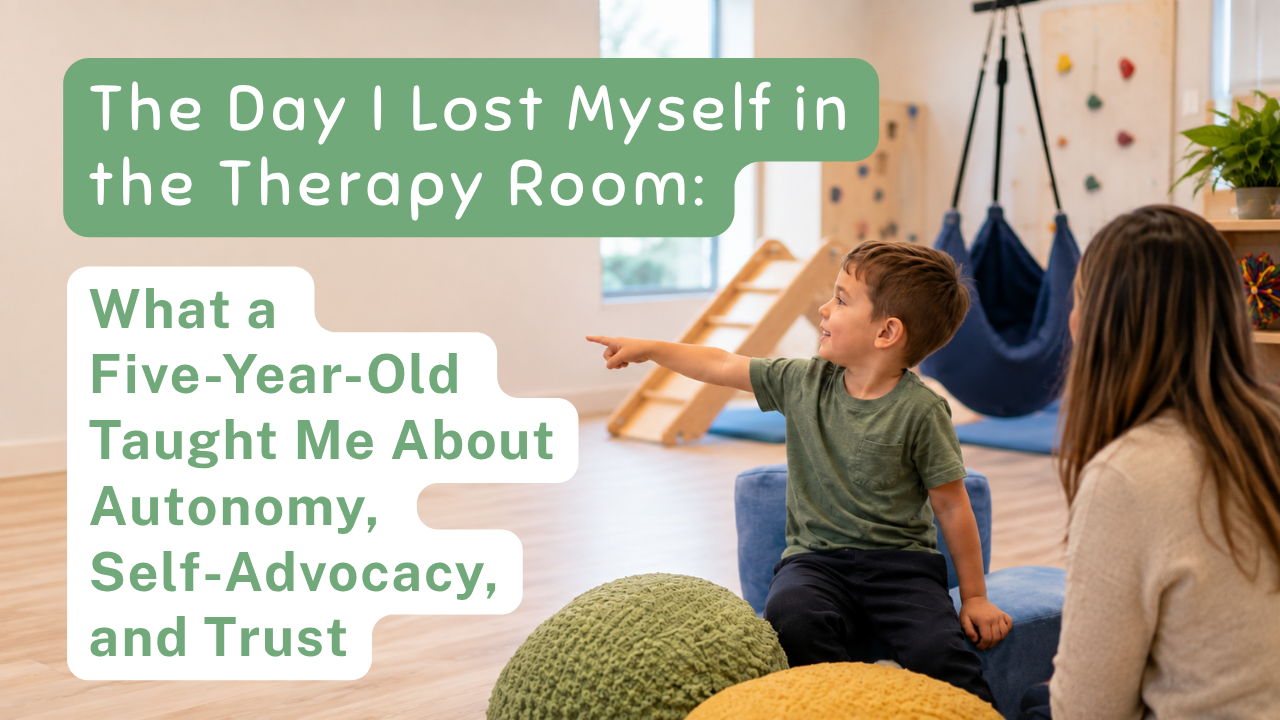
SenseUp Blog Series - Part 1 of 3
The Day I Lost Myself in the Therapy Room
What a Five-Year-Old Taught Me About Autonomy, Self-Advocacy, and Trust
I want to tell you about something that happened to me recently at work. It left me rattled, ashamed, and - eventually - more convinced than ever about why we do what we do.
I am sharing it because I think you might recognise it. Because I suspect it happens in therapy rooms more often than we talk about. And because I believe that the moments we are most ashamed of are sometimes the ones that teach us the most.
He is five years old. He has a primary diagnosis of a genetic syndrome and a secondary diagnosis of autism. He is minimally verbal, bright, and deeply present. He carries regulation items in his hands - they are part of how he moves through the world, how he stays anchored in environments that can be overwhelming. In sessions, we have always honoured that. We have always let him lead.
It started the week before. His mum came to me with concerns that were completely understandable. He was going too slowly. She couldn't see the progress. She worried he wasn't acquiring the school skills he needed. She wondered how he would ever cope.
I was genuinely glad she raised it. I believe parents are their child's greatest experts, and that open conversations - even hard ones - are good. I reflected on whether we had failed her somewhere. Had we given enough education? Had we communicated our reasoning clearly enough? Had we included her meaningfully in the process? And who else could be feeling this way and hadn’t let us know.
So I sat down and wrote a letter. A Parent Letter explaining our child-led approach, why we blend bottom-up and top-down strategies, and how this was all grounded in her son's neurodevelopmental profile. I was proud of it, honestly. I thought it might be the missing piece - the written explanation she could read at home with her husband, refer back to, and feel confident in.
I brought it to the next session.
She was grateful. But she also looked overwhelmed, so I suggested she take it home to read with her husband and come back with questions.
And then she said something I wasn't expecting.
At school, she told me, and at his other therapies, they remove the items he is holding to make him work. She'd watched it happen. He would put the items down, go to the table, and seem fine - even happy. She felt we were being too soft.
"He can't do this at school. How will he ever be ready if we don't make him work?"
I understood the fears of a mother who loves her son and is trying desperately to prepare him for a world that will not always be gentle with him.
I told her, again, about why regulation items matter. About the risk of losing trust. About the potential for masking. About how removing a child's self-regulation tools is not the same as building regulation. She disagreed. And I found myself in that particular kind of clinical bind that I suspect many of you know well.
I have always told parents they are their child's expert. I collaborate on goals. I work with families, not around them. And here I was - stuck.
So I asked her to describe exactly what happens at school. "She shows him a box," the mum told me, "and says to put his items in it. Which he does. And then they go to the table to work."
And then - and this is where I am most ashamed - I tried it too.
He looked at me with his beautiful big eyes. They filled with tears.
And then he said "no."
From a child who is minimally verbal. He communicated it clearly, honestly, and with every ounce of the self-advocacy that we had helped him build.
I was quietly, privately, heartbroken. And then I repeated the instruction and held out the box.
He dropped the items in. He sat down where he was. And he cried.
This is what I want you to sit with as we head into the next part of this story.
Because what I did in that moment was not neutral. I did not simply introduce a new routine. I overrode his autonomy. I dismissed his self-advocacy. And I asked him to trust me while doing something that broke exactly that trust.
These three values - autonomy, self-advocacy, and trust - are the quiet architecture of everything we do in the SenseUp Approach. Because they are the actual, neurological conditions under which a child's nervous system can feel safe enough to engage, to learn, to connect.
Autonomy
Autonomy is the reason child-led therapy works. When a child can act on their own sense of what feels safe, they are exercising the most foundational kind of agency. For a child with a complex neurodevelopmental profile, in a world that rarely feels designed for them, that agency is precious.
Self-Advocacy
His "no" was a miracle, honestly. A minimally verbal five-year-old telling me, clearly and directly, that he did not want to do what I was asking. That is a child who has learned that his internal experience matters enough to communicate.
Trust
Trust is the invisible infrastructure of every therapeutic relationship. It is built in tiny increments, through hundreds of small interactions where the child learns: this person is safe. This person follows my lead. This person will not ask me to override what my body knows. It can take months to build. It can be disrupted in a single moment.
I know this. I teach this. And I still did what I did.
I am not sharing this because I have resolved it neatly. I am sharing it because I think the messy, uncomfortable, in-the-moment reality of clinical practice is worth being honest about. Parental pressure is real. The desire to meet a family where they are is genuine and right. The wish to show a mum that you are listening and that you take her concerns seriously.
But we also know things that take years of training and clinical experience to understand. Sometimes our job is to hold that knowledge steady, even when it is uncomfortable. Even when a parent is looking at us with exhausted, worried eyes and asking us to just try it their way.
I did not hold it steady that day. And this little boy paid the price.
In Part 2, I want to talk about what that cost actually looks like - for him, for me, and for the relationship between us. Because what happened in the seconds after he dropped those items into the box is a story about nervous system safety, masking, cumulative trauma, and what is genuinely at stake when we ask a child to perform compliance. And in Part 3 I will talk about the repair, and another miracle goal that emerged on the backend of what was a session I will never forget.
This blog series is written in the lead-up to the SenseUp Masterclass: Autism Through the SenseUp Lens - Sensory Processing, Autonomic Regulation, and Neuroaffirming Practice. If you are an OT working with autistic children and you want a clinical framework that holds the whole child, I would love to see you there. Visit senseup.org for details.
Masterclass Collection <- Click to View
Sensory Features in Diagnostic Groups: Autism Masterclass <- Click to View
Yours in sensory,
Kerry
Stay connected with news and updates!
Join our mailing list to receive the latest news and updates from our team.
Don't worry, your information will not be shared.
We hate SPAM. We will never sell your information, for any reason.