Part 2/3: Understanding What Happened in His Nervous System and Mine
Aug 14, 2026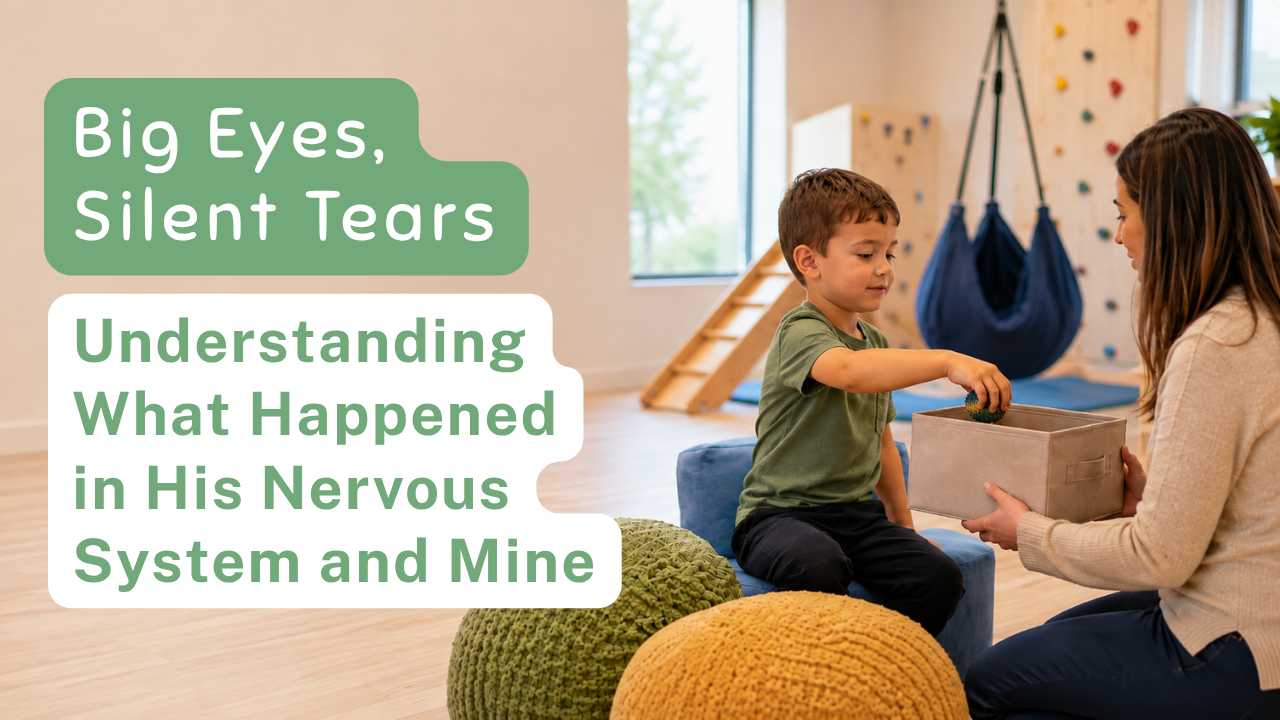
Big Eyes, Silent Tears
He dropped the items into the box.
He sat down where he was. And he cried.
I want to stay here for a moment, because I think it is easy to read that sentence and move quickly past it. To get to the "what happened next" and the repair and the moments that felt better. But the most important clinical story is in that small, quiet act of surrender.
He dropped the items. He sat down. And he cried.
What was happening in his nervous system?
This is what has been on my mind since it happened, and what I want to explore with you here. because it matters for every child on your caseload who has ever been asked to do something similar, by you, a teacher or a parent.
He is five years old. He has a primary diagnosis of a genetic syndrome and a secondary diagnosis of autism. He carries regulation items because they are his anchors and they are how his nervous system stays organised in a world that is often too loud, too bright, too unpredictable, too much. Those items are not a habit. They are a coping strategy, a self-regulatory tool that his nervous system has learned to use. He does not present as overtly over-responsive, if anything appears low registration in profile.
When I introduced the box and repeated the instruction after his "no", I was not simply introducing a new routine. From the perspective of his nervous system, I was removing his primary tool for self-regulation in an unpredictable moment. I was introducing an unexpected demand. And I was overriding the clearest communication he had given me.
That is a threat. Not an obvious one. Not a dramatic one. But a threat nonetheless, processed by a nervous system that was already working hard to stay organised.
In Polyvagal terms what I may have triggered was a shift from whatever regulated state he had been in, toward sympathetic activation. Not a meltdown. Not an explosion. Something quieter and, I think, more costly: a nervous system choosing to comply because the cost of resistance had just been made clear.
The tears and what they told me
When he cried, he was not having a meltdown. He was not in fight or flight. He sat down, quietly, and cried.
In clinical terms, I wonder whether what I witnessed was the early edge of a shutdown response. A nervous system that had said no, been overridden, and in the absence of any other option began to withdraw.
For autistic children, and particularly for children with complex neurodevelopmental profiles, the distinction between active distress and quiet withdrawal is important. The quiet response is the one we are most likely to interpret as compliance, as adjustment, as the child being fine with it now. It is the one most likely to be reported at school as he settled down quickly or he got over it.
The risk of masking
Here is what I cannot know for certain - but what I believe is clinically significant.
He had been building, over months, the capacity to put his regulation items down voluntarily. In recent sessions, he had been doing this intermittently and spontaneously. He had been putting his items down when he was needed to, was picking them up again. That developmental movement toward self-initiated flexibility had been growing, slowly yes, but still growing.
When I introduced the box, I did not build on that development. I bypassed it. And the risk is that what looked like compliance from the outside (he put the items down) was not the same as the inside-out regulation we had been carefully cultivating.
Masking, in autistic children, is exactly this: the performance of a regulated, compliant presentation that does not reflect the actual state of the nervous system underneath. The research is clear on what masking costs; anxiety, burnout, and the gradual erosion of the child's access to their own internal signals.
I do not know whether this episode created masking. But I know that compliance-based moments teach the nervous system something about what is and is not safe to express.
What happened to me
My heart was racing. I felt devastated. I knew in my body, not just my mind, that I had done the wrong thing.
I have been thinking a lot about why I continued past his "no." And I think it was the pull of multiple pressures converging at once: a mum sitting in the room who needed to feel heard, the fear of appearing too soft, the clinical bind of collaborating with families while also holding clinical knowledge that they sometimes do not have. And old habits of mine (not fully unlearned) in remaining neutral and repeating the instruction.
None of those things make what I did right. But I need to raise them because they are the real challenges we all come up against in clinical practice, and pretending they are not there does not make any of us better therapists.
What I can tell you is this: the shame I felt, and still feel, is the signal that my clinical values and what I had just done were in direct conflict. That shame is information. It is the nervous system's way of flagging an incongruence between who I believe myself to be and what I just did.
As uncomfortable as this is, I sat with it, I wrote about it and I am sharing it with you. I believe that the therapists who are willing to be honest about their mistakes are the ones who actually improve and I wanted to show you that I am human too.
The relationship
This is perhaps the hardest part to write about.
Before that moment, I believe he trusted me. Trust in a therapeutic relationship with a child like this is not a simple thing. It does not come automatically with time. It has to be earned, interaction by interaction, through hundreds of small moments where the child's experience is met with curiosity, where their no is honoured, where their self-regulation is supported rather than overridden.
We had that and then I introduced doubt.
I don’t believe that I destroyed what we had (in part 3 I will share the repair and how we ended the session). Children are more resilient than we sometimes give them credit for, and the relationship itself and the accumulated history of safe interactions is a buffer. But I also do not want to minimise it, because I think the field sometimes colludes in minimising these moments, particularly with children who cannot report them in words.
He is minimally verbal. He cannot go home and tell his mum: Kerry asked me to put my things in a box and I said no and she made me do it anyway and I cried. He communicates through his body, through his behaviour, through his willingness to engage. And his nervous system now has new information about what can happen in this room.
My job over the next sessions is to repair. To show him through action, that what happened was an anomaly rather than a pattern. That his no is still heard here. That his regulation items are still safe here. That I am still safe.
That repair is what I want to talk about in Part 3. To show you what this actually looks like, from the foundation of nervous system safety all the way up through occupation and back into relationship.
And it begins with footsie.
This blog series leads directly into our SenseUp Masterclass: Autism Through the SenseUp Lens - Sensory Processing, Autonomic Regulation, and Neuroaffirming Practice. We explore masking, compliance-based trauma, Polyvagal Theory, and the SenseUp Model in clinical depth - with the science to back every clinical position. Visit senseup.org to join us.
Yours in sensory, Kerry
Stay connected with news and updates!
Join our mailing list to receive the latest news and updates from our team.
Don't worry, your information will not be shared.
We hate SPAM. We will never sell your information, for any reason.