Why ADHD Is a Regulatory Disorder and What That Means for Your Practice
Sep 17, 2026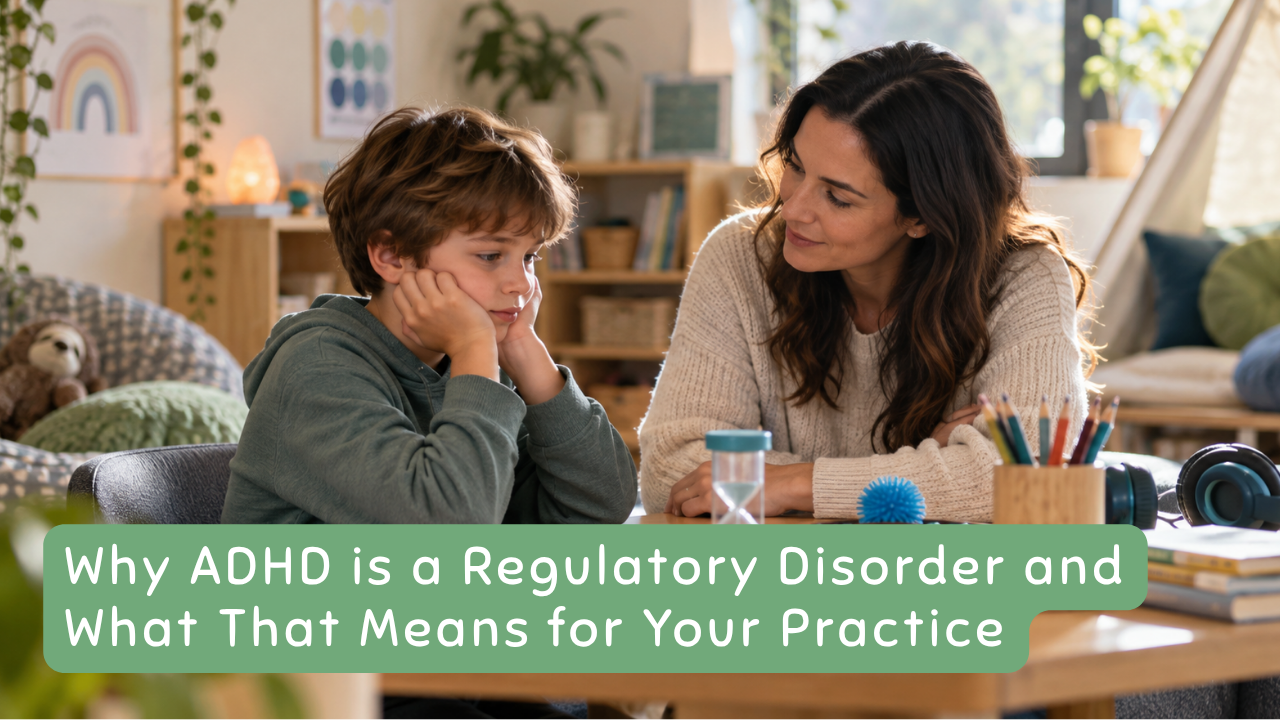
We have been taught that ADHD is primarily a disorder of attention. As OTs the job is to help children with focus, slowing down, strategies for organisation, and to help children to sit still long enough to get through a school lesson.
However the ADHD children on our caseloads are not simply inattentive. They are children whose emotions arrive as sudden, intense, and without adequate warning. Children who cannot regulate their arousal across the school day. Children who cry at the school gate, explode at homework time, and collapse into exhaustion by five o'clock. Children whose biggest challenges have almost nothing to do with attention and almost everything to do with regulation.
The science is catching up with what we have been observing in clinic for years. ADHD is not primarily an attention disorder. It is a disorder of hierarchical self-regulation and understanding it this way changes everything about how we assess, plan, and intervene.
What the Research Now Tells Us
The reframing of ADHD as a regulatory disorder is not new, but the evidence base supporting it has strengthened considerably in recent years. Russell Barkley's model positions ADHD as a deficit in behavioural inhibition and executive self-regulation with attention difficulties as a downstream consequence, not the root cause. More recently, a 2026 neurocognitive model proposed by Amiri and colleagues maps ADHD explicitly as a failure of hierarchical regulatory circuits: the brain's capacity to govern emotion, arousal, and impulse simultaneously, from the ground up.
A child with ADHD does not simply find it hard to pay attention. Their nervous system finds it difficult to regulate the arousal state within which attention must operate. When arousal is dysregulated, sustained attention becomes physiologically impossible.
|
🔬 RESEARCH SPOTLIGHT Amiri et al. (2026) — From brain circuits to self-regulation A 2026 model in Frontiers in Psychiatry proposed that ADHD is best understood as a failure of hierarchical self-regulatory circuits not primarily an attentional deficit. The model integrates evidence from neuroimaging, genetics, and clinical presentations to reframe ADHD as a disorder of top-down regulatory control affecting emotion, arousal, and impulse simultaneously. |
Emotional Dysregulation: Core, Not Co-occurring
Perhaps the most important clinical shift in recent ADHD research is the recognition that emotional dysregulation is a core, neurobiological feature of ADHD itself.
Studies suggest that between 25 and 45 per cent of children with ADHD experience significant emotional dysregulation including low frustration tolerance, rapid mood fluctuation, difficulty recovering from emotional events, and emotional responses that are disproportionate to the trigger.
One of the clearest pieces of evidence for this comes from a 2026 study by Gao and colleagues examining the effects of ADHD medication on emotional dysregulation. The finding was that both methylphenidate and atomoxetine improved emotional dysregulation independently of their effects on core ADHD symptoms such as inattention and hyperactivity. In other words, emotional regulation improved as a distinct target and not as a side effect of better attention. This tells us that emotional dysregulation in ADHD is a separable neurobiological target.
|
🔬 RESEARCH SPOTLIGHT Gao et al. (2026) — Medication and emotional dysregulation in ADHD A 2026 study in the Journal of Child Psychology and Psychiatry found that both methylphenidate and atomoxetine improved emotional dysregulation in children with ADHD independently of their effects on core attention and hyperactivity symptoms. This confirms emotional dysregulation as a distinct neurobiological feature of ADHD — and a separate clinical target in its own right. |
Rejection Sensitive Dysphoria and the Regulatory Lens
For many families, the most painful and confusing aspect of their child's ADHD is the emotional intensity. The child who falls apart at the slightest criticism. Who cannot tolerate feeling left out. Who perceives rejection in a sideways glance and responds as though something catastrophic has occurred.
This presentation, increasingly referred to as Rejection Sensitive Dysphoria, or RSD, is an expression of regulatory insufficiency. When the nervous system's capacity to modulate emotional intensity is compromised, ordinary social experiences like a friend choosing a different partner, a teacher's tone shifting, being told "no" activate a threat response that would be appropriate in a dangerous situation.
Understanding RSD through a regulatory lens rather than a behavioural one is transformative for families. Instead of "my child is too sensitive," the reframe becomes "my child's nervous system responds to perceived rejection with the same intensity it would respond to physical threat."
The Polyvagal Connection: Reading the Nervous System State
Polyvagal Theory, developed by Stephen Porges, gives us a compelling framework for understanding why ADHD children present the way they do across the day. The theory describes three physiological states: ventral vagal (safe, socially engaged, regulated), sympathetic activation (mobilised, fight-or-flight), and dorsal vagal (shut down, collapsed, frozen).
Children with ADHD spend a disproportionate amount of their day outside the ventral vagal window. In the morning, they may be in a low-arousal dorsal state - slow, difficult to rouse, apparently unmotivated. By mid-morning, the demands of the school environment have pushed them into sympathetic activation. By afternoon, the cumulative arousal loading tips them into the explosive, flooding state that families and teachers experience at home time.
Heart rate variability (HRV) — a physiological measure of autonomic flexibility — is consistently lower in children with ADHD than in neurotypical peers. Lower HRV indicates a nervous system with less capacity to flex between states, less resilience to arousal loading, and less ability to return to regulation.
Practical Clinical Suggestions: Where to Begin
|
🌿 Reframe the referral picture before you begin ● When a child is referred for "emotional outbursts" or "explosive behaviour," resist framing the work as behaviour management. Name it explicitly: "We are going to look at what is happening in the nervous system that makes emotional regulation so difficult." ● Share the regulatory model with families at the first appointment. A simple explanation "ADHD affects the part of the brain that manages emotions, not just attention" reduces shame and increases engagement with intervention. |
|
🌿 Assess the full regulatory day, not just the clinic presentation ● Use a 24-hour lens: morning arousal, school arousal loading, transition flashpoints, after-school collapse, and evening escalation. The full arc tells you far more than any single observation.
|
|
🌿 Build co-regulation before self-regulation ● Self-regulation develops through co-regulation. A child whose nervous system is frequently flooded cannot develop regulatory capacity without a regulated adult to borrow from. |
|
🌿 Make emotional regulation explicit and educational ● Older children (8+) benefit from understanding the neuroscience of their own experience. Use age-appropriate language: "Your brain has an alarm system and in ADHD, the alarm is extra sensitive. It goes off before you've had time to think." This is validating, not excusing. |
The shift from "attention deficit" to "regulatory disorder" reorients the clinical question from "how do we get this child to pay attention?" to "what does this child's nervous system need in order to feel safe enough to participate?" That is a question occupational therapists are uniquely trained to answer.
When we understand ADHD as a regulatory disorder, we stop waiting for attention to appear and start building the conditions within which regulation — and therefore attention — becomes possible.
|
✦ JOIN THE MASTERCLASS Masterclass 2 — ADHD as a Regulatory Disorder: Understanding the Nervous System Through a Polyvagal Lens 🙂👉 Learn More About the Masterclass This blog is a glimpse. The masterclass gives you the full clinical framework — how to assess, how to explain it to families, and how to make emotional regulation the spine of your ADHD intervention. senseup.org | [email protected] |
© 2026 SenseUp Training. For professional development use. Not for clinical distribution.
Stay connected with news and updates!
Join our mailing list to receive the latest news and updates from our team.
Don't worry, your information will not be shared.
We hate SPAM. We will never sell your information, for any reason.