Part 3/3 - The Repair: From Foundation to Footsie to Socks And Why He Didn't Want to Leave
Aug 17, 2026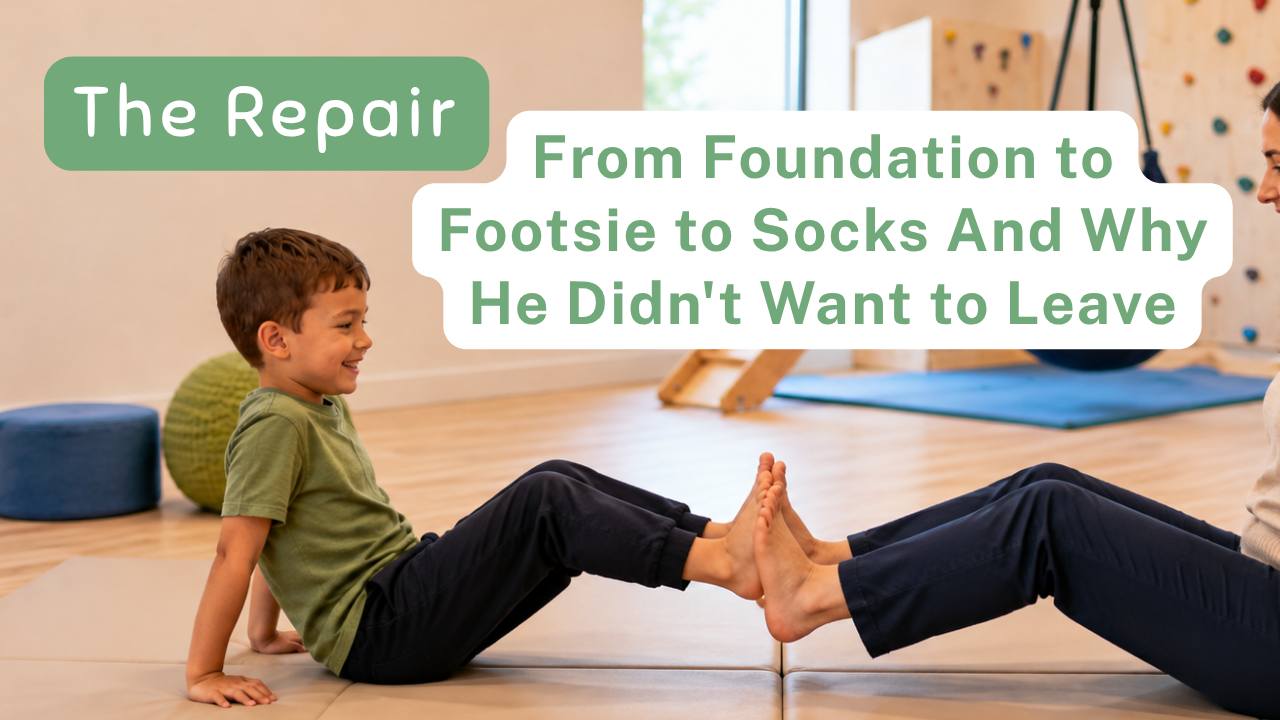
SenseUp Blog Series - Part 3 of 3
The Repair
From Foundation to Footsie to Socks And Why He Didn't Want to Leave
This is the final post in a three-part series.
- Part 1 tells the story of what happened and what it revealed about autonomy, self-advocacy, and trust. Part 1 - The Day I Lost Myself in the Therapy Room
- Part 2 explores the neurological and relational cost of that moment. This post is about what came next. Part 2- Understanding What Happened in His Nervous System and Mine
Racap from where we left off in Part 2.
He dropped the items into the box. He sat down. And he cried.
I sat down with him, on the floor, where he was.
The twenty minutes that followed ended up being the most beautiful interaction. And I will take you through what emerged, and how he and I found our way back.
The Foundation: Nervous System Safety
The first thing I did was sit across from him. I used a prosodic voice softened, slower, with a gentle rhythm. I offered reassuring words, through tone rather than content, that the threat had passed. We're okay. I've got you. We're just sitting.
This is the Foundation level of the SenseUp Model, nervous system safety. A state of being that one regulated adult offers to one dysregulated child. Polyvagal Theory gives us the language for this: the social engagement system, activated through prosodic voice, gentle eye contact, and facial expression, is the most powerful co-regulatory tool available to us, and this little boy responded.
Gradually, his breathing changed. His body loosened, just a little. He looked up.
Finding His Own Regulation
He got up and went to find something else to hold and then came back.
He self-regulated. He identified what his nervous system needed and he went and got it.
That is the Foundation Level of the SenseUp Model in action. His nervous system knew what it needed and sought it. Our months of child-led, sensory informed practice has been working. He had internalised, at a nervous system level, the capacity to reach for regulation when things became difficult.
And now he held that new item even more tightly than the previous ones. Which tells us exactly what you might expect: his threat-detection system was still active. He needed more support and not less.
I let him hold it. Of course I did. I had had a huge reminder to be responsive. To be me with him.
Footsie: The Child-Led Return
And then he initiated footsie.
I love this moment so much that I cannot write about it without smiling. This small, five-year-old boy who had just cried after a moment of broken trust, looked at me and invited play. He initiated contact. He chose connection.
We played footsie. Feet touching, pushing, responding. Him leading, me following. Smiles.
In sensory terms, this was rich and purposeful: tactile input through the soles of the feet, deep pressure, proprioceptive activation, rhythmic and reciprocal interaction. The feet have a significant tactile nerve supply and are powerful proprioceptive receptors. The input was organising and regulating for both of us.
This was Level 1 & 2 of the SenseUp Model: sensory-motor integration, embedded in relationship, driven entirely by his own initiative.
The Socks: Occupation, Arrived At Honestly
After a while we moved toward socks. I had taken mine off to meet his feet skin to skin. The I playfully placed my sock over his toes and he laughed. Then he pulled on it as if to pull it on (one handed as he was still holding tight to his regulation item). So, I assisted him and once he had it on and waved his foot around. I showed him his sock and we had a giggle. Then he pulled my sock off his foot independently, and I handed him his sock “sock on”. I backward chained, building on the sock practice already done in other sessions, and he pulled it the rest of the way for the first time J He was pleased with himself.
This is Level 4 of the SenseUp Model: occupational participation. The functional skill. The goal that a parent might point to as the evidence of progress. And here it was emerging not from a structured demand, not from items being removed to make him comply, but from a nervous system that had been offered safety, a body part enriched with sensory input to support body awareness, and then when he was ready engaged with the task at hand.
Would two hands have been more effective in task completion – yes! But would he have completed the task if he hadn’t been allowed to hold his regulation item – unlikely. Did learning (through neuroplasticity) happen – yes. Does compliance-based learning lay down new neural pathways in the presence of threat – no. Stephen Porges tells us that sensory integration cannot occur in the presence of threat.
He tried. He focused. He ‘worked’. And he did it with the item in his hand, because that is what his nervous system needed in order to be available for the task. The item was not in the way of the occupation. The item was the reason the occupation was possible. Is this what neurodiversity affirming therapy looks like – I think yes (not the box part!).
He Didn't Want to Leave
When the session ended, he did not want to go.
His nervous system had been co-regulated enough, and repaired enough, that the therapy room still felt like a good place to be. He still felt safe. He still wanted to play.
That is what repair looks like. It does not erase what happened. It does not pretend the difficult moment did not occur. But it demonstrates through action, through presence, through following his lead all the way from the floor back to socks and back to smiles that our relationship survived.
What this tells us, clinically
The SenseUp Model 360 describes nervous system safety at the foundation, then integrated sensory processing, then sensory-motor integration, then occupational participation at the top. But the point is not the hierarchy but the direction of travel. We build upward from safety, not downward from task completion.
What I witnessed in that final twenty minutes was a child moving naturally through every level of that model, at his own pace, in his own order, following his own internal compass. He restored his nervous system safety through my regulated presence. He sought his own sensory regulation. He initiated play and connection. And then, when he was ready, he engaged with occupation.
For the mum
There is a postscript to this story, and it matters.
After the session, his mum and I had a conversation that I think was genuinely productive. She was able to see why child-led practice looks the way it does. She acknowledged the worry and grief underneath her original concerns: the fear that he might not be school-ready, that his progress was too slow, that she was failing him somehow. My job in the sessions with him and in the conversations with her is to help her find safety too.
We are not there yet. But we are further along than we were. And I think we are further along because of what happened in that difficult session.
A final thought, for you
If you have read all three of these posts, you have spent time with one small, difficult story from one therapy session.
I shared this because I think we do not talk enough about the moments where we lose our way. We share the breakthroughs and the outcomes and the strategies, the “wins” but not the tricky times.
This little boy taught me so much, reminded me who I am and why I do what I do at SenseUp Therapies and SenseUp Training.
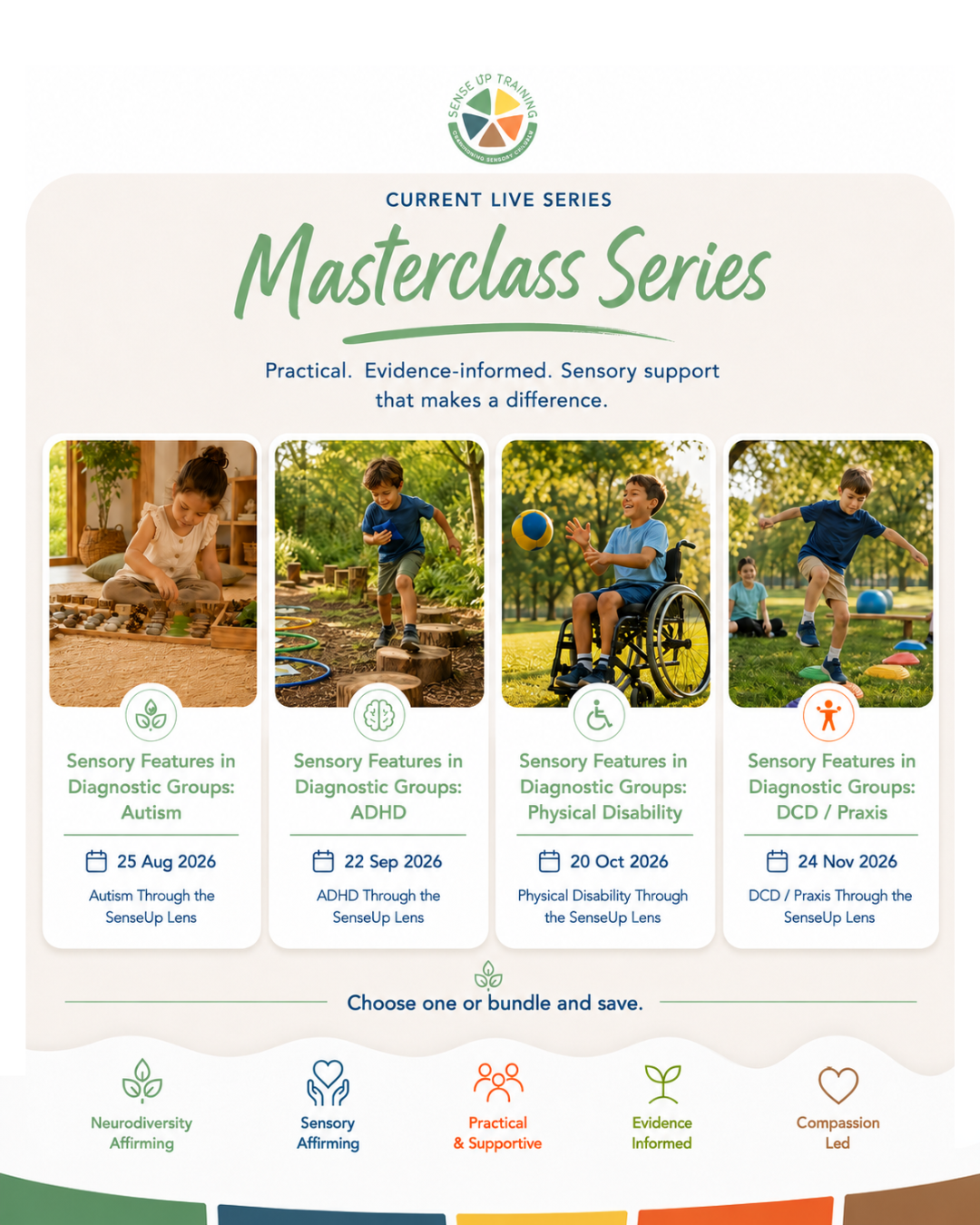
The SenseUp Masterclass - Autism Through the SenseUp Lens - brings together Polyvagal Theory, sensory processing, neuroaffirming practice, masking, and the SenseUp Model into one integrated clinical framework for paediatric OTs. If this story has stirred something for you, if you have your own version of this session somewhere in your clinical history, I would love to take you deeper into the science and the practice that helps us understand what is really happening - and what to do about it. Visit senseup.org to register. I cannot wait to see you there.
Learn more about the next Masterclass here:
https://www.senseup.org/Sensory_Features_in_Diagnostic_Groups-Autism/
Yours in sensory,
Kerry
Stay connected with news and updates!
Join our mailing list to receive the latest news and updates from our team.
Don't worry, your information will not be shared.
We hate SPAM. We will never sell your information, for any reason.